HealthFull
Guided care for complex medical journeys.


Project Overview
An intelligent, AI-powered platform that empowers patients with chronic or severe illnesses to manage all aspects of their condition in one accessible place. The platform reduces anxiety, helps patients navigate complex medical and bureaucratic challenges, and proactively identifies emerging patient needs throughout the journey.
The Core Challenge
"I don't know what to do, where do I even start?"
Managing a chronic or severe illness involves far more than medical treatment. Patients must navigate an overwhelming maze of documentation, appointments, medications, and bureaucratic procedures, often spread across multiple platforms, while also coping with physical symptoms, emotional stress, and uncertainty.
Research & Insights
User Research Key insights
To better understand the challenge, I conducted user interviews and a survey, alongside a competitive analysis, to explore patient needs, behaviours, and gaps in existing solutions.
Need for guidance from the start
Newly diagnosed patients and their caregivers often do not know where to start or what steps to take.
“I made a lot of mistakes at first… I got confused and forgot things… I felt completely lost.”
Bureaucratic complexity
Around 70% of participants reported difficulties navigating procedures with National Insurance and other medical institutions.
“If there was a process that highlights what's relevant, centralizes documents, emphasizes key points, and sends reminders.”
Multiple tools for medical management
Most participants relied on multiple digital tools to manage their complex medical information, which made the process more difficult and confusing.
"A lot of information needs to be pulled at the moment… it’s hard to predict what will be required when and to keep it well organized.”
Competitive Analysis
To understand the existing landscape and identify gaps, I examined the tools and services patients with severe and chronic illnesses currently rely on.
Task & Document Management Systems
General-purpose tools used to organize tasks, documents, and track deadlines
Strengths
-
Efficiently organize tasks and information.
-
Accessible across a range of devices.
-
Enable tracking of deadlines and progress.
What’s missing
-
Not designed for managing illness.
-
Provides no guidance on what to track or when.
-
Focuses solely on organization; ignores emotional, bureaucratic, and medical needs.
UX Insight
Patients need guidance and context beyond task management. This gap highlights the opportunity for a system that combines organization with health-specific guidance.
Medical Advisory & Patient Support Organizations
Professional services providing medical guidance and support for patients
Strengths
-
Provide professional medical knowledge and guidance services.
-
Provide personalized human support.
-
Help navigate complex procedures and rights.
What’s missing
-
Often costly and not accessible to all patients.
-
Support is typically physical, not digital.
-
Creates dependency on external assistance.
UX Insight
While these services offer expertise and reassurance, patients still lack one integrated digital tool for managing their condition.
Social Media Groups & Online Communities
Online communities where patients share experiences, ask questions, and support each other through their journey
Strengths
-
Enable peer-to-peer knowledge sharing.
-
Provide emotional and social support.
-
Free and highly accessible.
What’s missing
-
Information is not always structured or reliable.
-
Lacks privacy for sensitive medical data.
-
No structured support for end-to-end disease management needs.
UX Insight
These platforms provide community support but cannot replace a structured, guided system for holistic disease management.
Research Synthesis: Key Gaps
No existing solution addresses the full spectrum of patient needs. Patients must juggle multiple disconnected tools while managing their illness, adding complexity when they need simplicity most.
The opportunity
Create an integrated platform that combines the organization of digital tools, the expertise of professional guidance, and the support of community, all in one intelligent, accessible system.
Project Goal
To provide an intelligent, comprehensive management tool that addresses all aspects of disease management for patients and their families, accessible anytime, anywhere.
Persona

Dana Brit
"I don't know what to do, where do I even start?"
Age: 56
Health status: Recently diagnosed with a rare autoimmune disease.
Background
Dana was diagnosed two months ago with a rare, life threatening autoimmune disease. Following the unexpected diagnosis, she had to stop working and adapt to intensive treatment, frequent hospital visits, and complex medical and bureaucratic processes.
Needs & Goals
-
clear guidance on what steps to take and when.
-
Centralized management of medical information and personal documents.
-
Confidence when facing medical committees and complex procedures.
Frustrations
Information scattered across multiple systems, leading to fear of missing critical steps.
UX Insight
Patients like Dana need more than organizational tools, they need structured guidance and reassurance throughout high-stress situations.
User Flow
Medical committee preparation flow

The Solution
Concept Exploration
Mission concept

Support and
guidance concept

Smart disease management concept

From Concept to Design
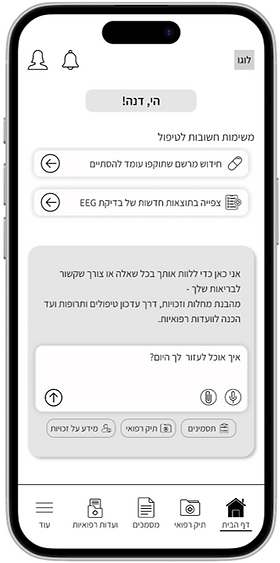
After exploring three different directions, the Mission concept, the Support and Guidance concept, and the Smart Disease Management concept, I chose to focus on the Smart Disease Management approach.
While the Mission concept focused on task organization, and the Support and Guidance concept emphasized reassurance and guidance, both addressed specific parts of the experience.
The Smart Disease Management approach brings these aspects together into a single system, combining organization, guidance, and AI-driven support.
This direction aligns with the research insights, which highlighted the need for a more holistic solution that reduces fragmentation and supports patients throughout their journey.
Wireframes




System Intelligence in Action
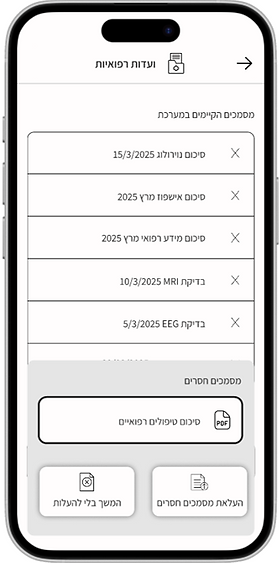
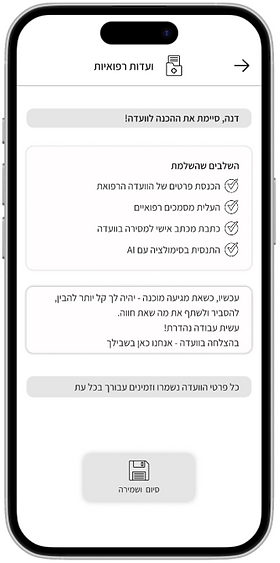
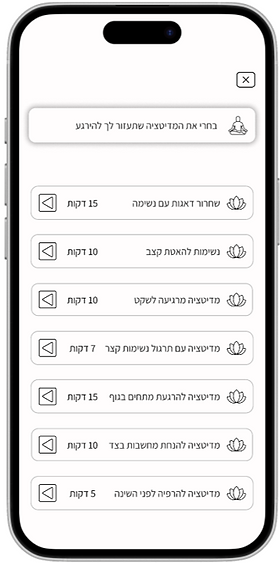
During the medical committee preparation, Dana engaged with the AI through guided summary writing and a medical committee simulation.
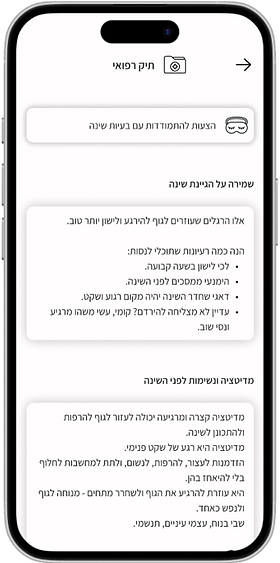
The system identified recurring signals related to potential sleep difficulties.
Rather than interrupting her task, the platform waits until Dana completes or exits the committee preparation flow, then proactively and gently offers targeted support.
This moment demonstrates the system’s core value:
Supporting patients beyond bureaucracy, by proactively addressing real-life challenges as they emerge.





.png)